


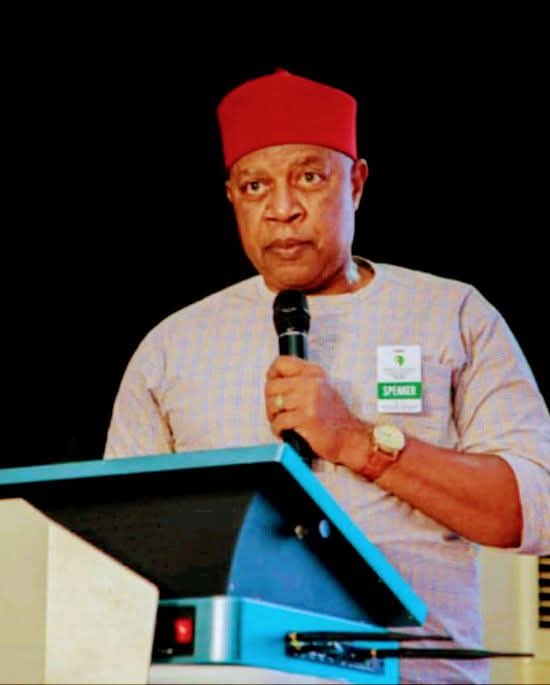
The Life and Legacy of Dr. Emeka Fleming Okengwu. 1 January 1964 – 10 May 2026
The RockPost family received the news of Dr Emeka Fleming Okengwu’s passing on Sunday, 10 May 2026, with profound shock and sadness. His departure, following a brief illness, was as sudden as it was devastating. It is the kind of loss that leaves a silence where a formidable voice once stood.
Born on 1 January 1964 and educated at the University of Nigeria Nsukka, New York State University, the University of California and the ITTL Doctoral Research Centre, Dr Okengwu was a man of uncommon intellectual breadth. He held a PhD in Development Economics alongside degrees in Political Science and Entrepreneurship — a combination that positioned him uniquely at the intersection of policy, industry and national transformation.
THE MAN BEHIND THE CREDENTIALS
Yet the man behind the credentials was, in many ways, more remarkable than the credentials themselves. He taught when occasion called for it — not as performance, but because he genuinely believed knowledge was meant to be shared. He read widely and purposefully, counting the Bible and the Holy Quran as his two most treasured books, having arrived at the quiet conclusion that all the knowledge a man could ever seek resides within their pages. And he slept (deeply and without guilt) understanding, as only the truly wise do, that rest is not laziness but the foundation upon which everything else is built. These three habits (teaching, reading and resting) were not incidental to who he was. They were the architecture of a life lived deliberately.
That life had been shaped by giants. He credited Dr. Ali Adamu as the first person who made him truly believe in himself and in his own capacity as a young man — a debt of influence he carried and never forgot. Prof. Ijeoma Okengwu, his father, sharpened him intellectually. He consciously replicated his father’s careful moulding in raising his own children. This gave him his spine and standard. He described his mother, simply and with unmistakable tenderness, as his hero and best friend. She believed in him when belief mattered most. Alongside these foundational figures stood Abdulsalam, a loyal companion who had moved with him from the very beginning and never left his side.
What emerged from these influences was a man of settled, unshakeable interiority. He counted his greatest personal achievement not as any title, award or appointment — of which there were many — but as something far less visible and far more difficult to attain: he had found peace and conquered fear. He no longer looked to others for validation or direction. He had learned and lived, as though he possessed all three things God considers sufficient for a man — food, clothing and shelter. In a world that measures achievement by accumulation and status by noise, Dr. Okengwu measured achievement by sufficiency and status by stillness. That philosophy, more than any consultancy or commendation, is perhaps his most enduring lesson.
AGRICULTURE AND AGRO-INDUSTRIAL TRANSFORMATION
It was from this grounded centre that his extraordinary public life radiated outward. As executive director of Biosources and Technologies Limited, he led a pioneering public-private partnership focused on bioethanol development from cassava, championing Nigeria’s agro-processing industry at a time when its agricultural potential remained largely unrealised. His membership of the Technical Working Committee of the National Agricultural Transformation Implementation Plan (NATIP) under the Federal Ministry of Agriculture and Rural Development — a body on which he served for several years — brought rigour and vision to one of Nigeria’s most consequential agricultural reform initiatives. He brought to that work the conviction that Nigeria’s land and people, properly supported, could feed and fuel a continent.
In manufacturing and industrial development, he served as resource person and consultant for the Ministerial Committee charged with developing the Proof of Concept and Outline Business Case for Methanol Fuel Technology in 2021 — work that sat at the frontier of Nigeria’s energy transition ambitions. He was also passionate about developing innovative strategies for leveraging diaspora assets for the country’s sustainable development, recognising that Nigeria’s greatest underutilised resource may well reside beyond its own borders.
MINING, SOLID MINERALS AND NATIONAL PLANNING
His contributions to Nigeria’s mining and solid minerals sector were among the most sustained and consequential of his career, spanning nearly two decades of continuous engagement. He conducted a scoping study on the Nigerian mining sector for the Canadian International Development Agency (CIDA) in 2012 — the same year he served as consultant to the Central Bank of Nigeria. He had earlier consulted for the United States Embassy in Lagos in 2010 and returned to CIDA as a consultant in 2011.
From 2013 to 2016, he served as national strategy development consultant on the World Bank-supported External Funded Output (EFO) for the Nigerian mining sector — one of the most significant advisory roles of his career. In 2013, he also consulted on the review of technical audit bids for both the Ajaokuta Steel Plant and the Nigerian Iron Ore Mining Company (NIOMCO), two of Nigeria’s most strategically important industrial assets. He consulted for the Solid Minerals Development Fund (SMDF) on the development of the Uburu salt deposits in Ebonyi State and for the Benue State government on the assessment of coal deposits in Owukpa. He served on the working group reviewing fiscal and legal frameworks for the solid minerals sector and was a consultant to the Council of Nigerian Mining Engineers and Geoscientists (COMEG) on the accreditation of professional and related courses in tertiary institutions across Nigeria. It is a measure of the trust his peers placed in him that Hajia Fatima Shinkafi, the executive secretary of the SMDF, counted Dr. Okengwu as a shoulder to lean on for honest professional counsel — someone she turned to for insight and guidance as she found her footing in the sector, and whose opinion she continued to seek long after she had found it.
His national planning engagements were equally far-reaching. He was a member of the National Technical Working Group for Vision 20-20-20 in 2010 and of the National Technical Working Group for Nigeria’s 30-Year National Infrastructure Development Plan (NIIMP) in 2015 — twin frameworks that sought to project Nigeria’s economic trajectory across generations. He also consulted for the Ministry of Niger Delta Affairs on the request for proposal for a five-year integrated infrastructure development programme for the Niger Delta Region in 2010 and contributed as a discussant to the roundtable addressing the challenges of lead poisoning in Zamfara State, demonstrating that no dimension of national development fell outside the arc of his concern.
LEGISLATIVE AND CIVIC ENGAGEMENTS
Legislative and civic engagements further demonstrated the breadth of his service. He consulted for the 7th Senate Committee on Aviation in 2012 and chaired the Minerals and Steel Committee of the Buhari Support Organisation (BSO) in 2015. In 1999, he served as discussant at the National Workshop on Tranquillity Through Religious Tolerance and Peaceful Co-existence — an early signal, in a career defined by economic and industrial concerns, that he understood nation-building to be a moral and social enterprise as much as a technical one.
A VOICE ON THE WORLD STAGE
As a presenter and thought leader, Dr. Okengwu carried Nigeria’s voice to the world’s most consequential platforms. In 2006, he presented on the global development of mineral resources at the World Bank headquarters in Washington DC, addressing the International Conference on Sustainable Management of Mineral Resources. In 2007, he addressed the Commonwealth Business Development Conference on sustainable infrastructure development in Africa, held in South Africa. In 2016, he delivered papers on the role of mining in sustainable economic development at the enlarged National Economic Council (NEC) Retreat at the State House in Abuja. These were not ceremonial appearances — they were substantive contributions from a mind that had done the work and earned the platform.
HONOURS, FAITH AND FAMILY
A patron of the International Human Rights Commission (IHRC) Geneva for Africa, Dr. Okengwu held the traditional titles of Ipigbe Weppa-Wanno and Ikenga Oru-Ahiara — honours that reflected the depth of respect he commanded across both the global and the deeply local. A Christian to the core, he was a devoted husband and father whose faith was not decorative but structural, informing his values, his choices and the way he engaged the world. He was, by every account, the same man in the boardroom as he was at home, at his desk and on his knees. That his life’s journey took him across every boundary Nigeria draws between its peoples was itself a testament to the man: he found the love of his life in Jim Emeka, a native of Adamawa State, with whom he built and raised his family — a union that spoke, quietly and without fanfare, of a Nigeria he believed in and embodied.
LEGACY
Renowned for his outspokenness in defence of justice, equity and transparency, his passing leaves a vacuum in Nigeria’s mining, industrial and development policy spaces that will not easily be filled. What he built through decades of service, scholarship and sacrifice (the frameworks shaped, the policies influenced, the young minds encouraged) are legacies that will continue to speak long after his voice has fallen silent. Among those whose careers he shaped and spirits he lifted is Deinsam Ogan, a geologist and scholar based in the United Kingdom, who has spoken of Dr. Okengwu as a profound and enduring inspiration — a reminder that the reach of a great mind does not stop at any border.
And in the hearts of those who knew him (as a mentor, a colleague, a friend and a guide), the silence will be loudest of all.
To all who worked alongside him, sought his counsel or were inspired by his vision, the RockPost family shares your grief.
Adieu, Dr Emeka Fleming Okengwu. May your soul, and the souls of all the faithful departed, through the mercy of God, rest in peace. Amen.

